Technical Guides 7 min read
Overhead Crane Manufacturing: How a Crane Is Built, Step by Step
From structural calculations to blast cleaning and factory tests: the stages of overhead crane manufacturing, what is checked at each one, and how to judge build quality as a buyer.
Ervan Cranes Engineering

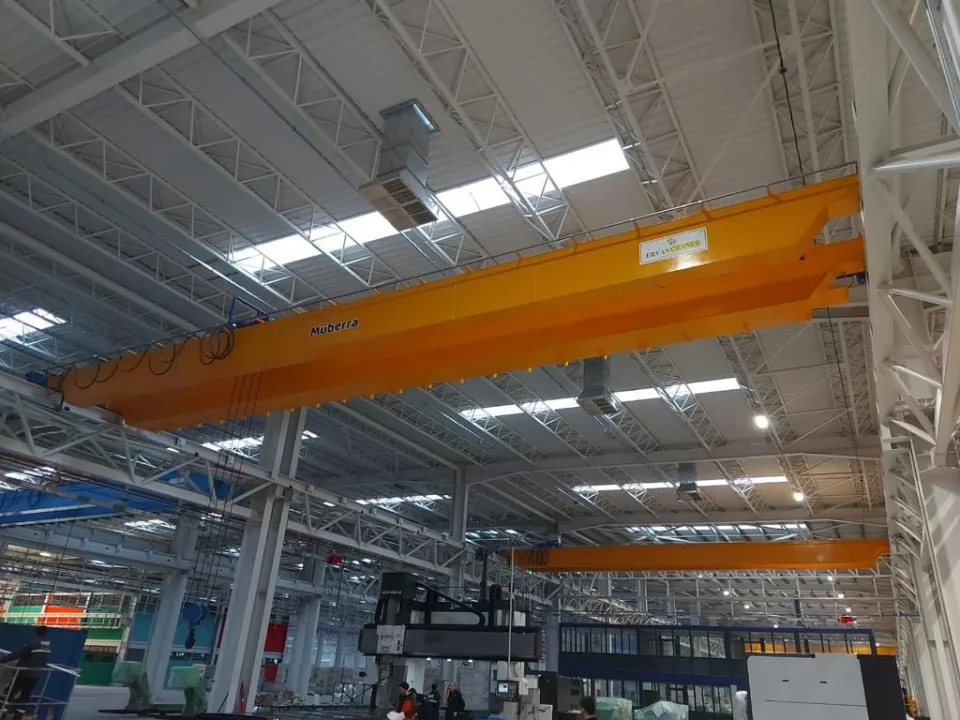
Overhead crane manufacturing runs from engineering through steel cutting and girder welding, assembly of the end carriages and trolley, painting and electrical work to factory checks and shipping. Each stage has its own quality checks, and knowing them is the most reliable way for a buyer to judge build quality before the crane reaches site.
Overhead crane manufacturing step by step
Between order and dispatch, a crane typically passes through these stages:
- Technical clarification: load, span, lifting height, duty class, speeds, controls, power supply, environment and building data are fixed in a specification.
- Engineering: structural and mechanism calculations, drawings, electrical diagrams and the bill of materials.
- Materials: plates and sections ordered by grade and checked on arrival.
- Cutting and preparation: plates cut to size, weld edges bevelled.
- Girder fabrication: box girders welded from webs, flanges and diaphragms, or rolled sections prepared.
- Dimensional checks: camber, straightness and key dimensions measured.
- End carriages: wheels, bearings and travel drives fitted.
- Trolley and hoist: rope or chain, hook block, brakes and limit switches assembled.
- Surface treatment: blast cleaning and a coating system matched to the environment.
- Electrics: control panel, wiring and protective devices.
- Factory checks: pre-assembly, function tests and the documentation file.
- Packing and shipping: parts marked, protected and loaded.
Engineering: the crane is decided on paper
Much of a crane's quality is fixed before any steel is cut. Working from the specification, the engineers size the girders, end carriages and mechanisms. In Europe the usual basis for the structure is the EN 13001 series together with EN 15011 for bridge and gantry cranes, covering static strength, fatigue and the buckling stability of thin plates.
The key input is the duty class: how many load cycles or running hours the crane will see, and at what share of its rated load. That is why two cranes with the same capacity and span can differ considerably in weight and cost. Our article on crane duty classification explains the FEM, ISO and CMAA systems.
Deflection is checked as well, which is a stiffness question rather than a strength one. A girder can be strong enough and still sag so far that the trolley runs uphill, so girders are given a camber, typically sized to offset the dead-load deflection plus part of the live-load deflection. The stage ends with workshop drawings, a bill of materials, electrical diagrams and a risk assessment to EN ISO 12100.
Steel, cutting and girder welding
Materials
Crane structures are usually made from structural steels such as S235 and S355 to EN 10025-2. Good practice is to order main plates with EN 10204 type 3.1 inspection certificates, so that grade and properties can be traced back to the heat. For cranes in cold environments, the impact-toughness quality of the steel matters as much as its strength.
Box girder or rolled section?
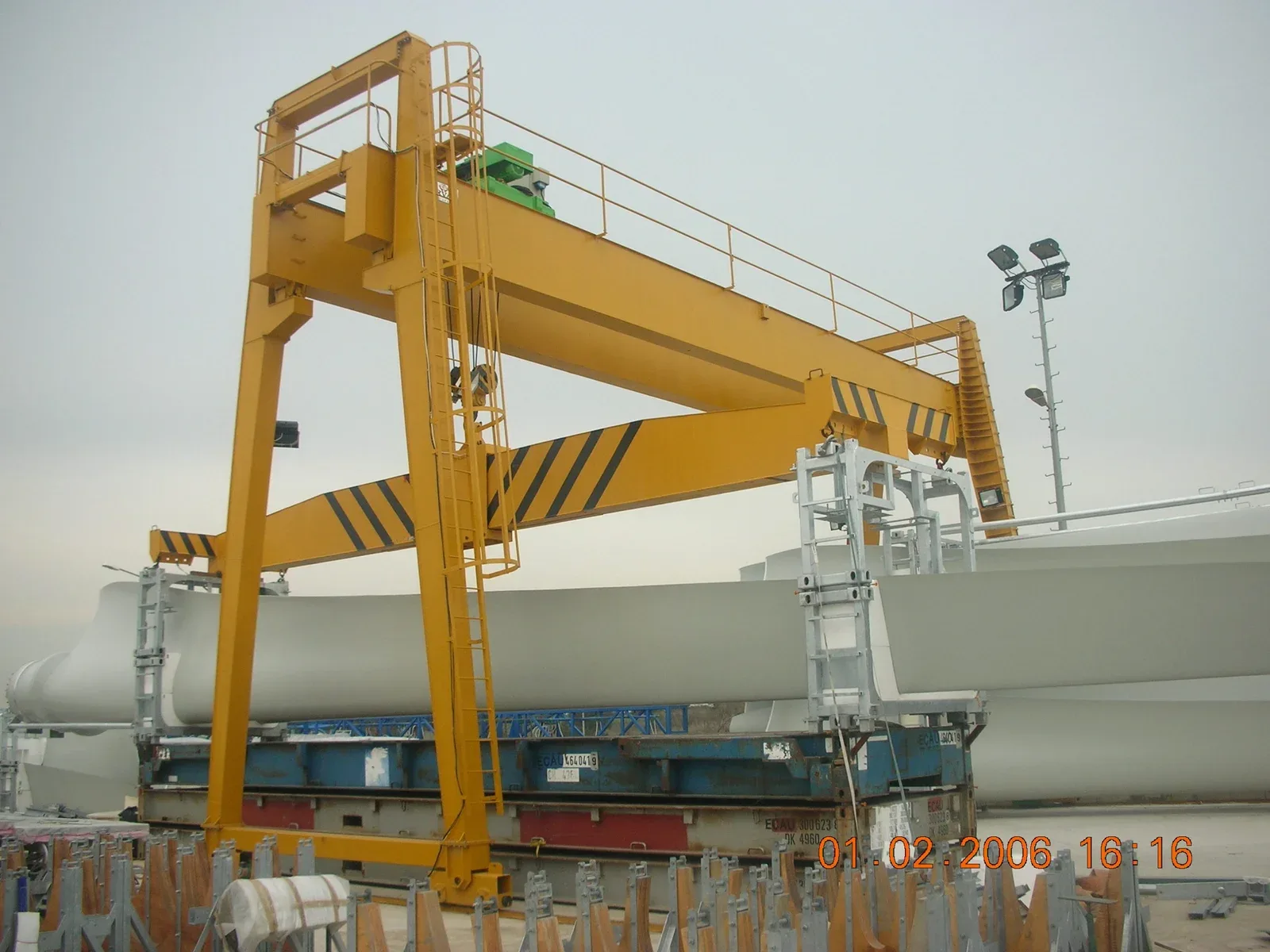
Single girder cranes with moderate spans often use a rolled I-section, sometimes reinforced with welded plates. Longer spans and double girder cranes usually have welded box girders: two webs, a top and a bottom flange, and internal diaphragms that hold the cross-section in shape. Deep girders may also need longitudinal stiffeners against web buckling.
Cutting, welding and inspection
Plates are cut thermally, by plasma, oxy-fuel or laser, and edges are bevelled where full-penetration welds are specified. The girder is tacked in a jig and welded in a planned sequence to keep distortion under control. Welders qualified to EN ISO 9606-1 and welding procedures qualified to EN ISO 15614-1 are established good practice.
Inspection scales with a weld's importance. All welds are inspected visually; critical butt welds, for example in tension flanges, are typically checked by ultrasonic testing, and magnetic particle testing is used where surface cracks are a concern. Under EN 13001-3-1, the fatigue strength assumed for a weld detail depends on its quality level to EN ISO 5817, so the required level and the inspection scope belong on the drawing.
Camber, straightness and squareness
After welding, each girder is measured: camber, straightness in plan (sweep) and the alignment of the trolley rail seats. Camber is produced during fabrication, usually by cutting the webs to a curved profile, not by bending the finished girder.
When girders and end carriages are joined, the bridge must be square. The two diagonals of the bridge frame are compared, along with the span and the wheel alignment. An out-of-square bridge or misaligned wheels make the crane skew on its runway, which wears wheel flanges and rails quickly. Tolerances come from the design and the applicable standards, and the results belong in a dimensional report.
End carriages, trolley, hoist and electrics
End carriages carry the wheels, bearings and travel drives, usually geared motors with integrated brakes. Wheel seats are machined so that the wheels run parallel and track true along the rail. The connection to the girders is often bolted, which also allows the bridge to be shipped in parts.
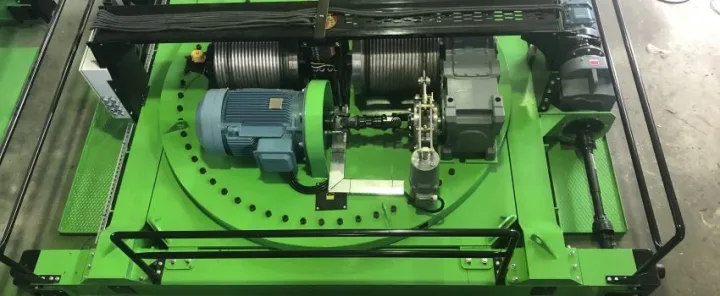
Single girder cranes often use a serial wire rope or chain hoist on a trolley that runs along the bottom flange. Double girder cranes use a trolley frame carrying the hoist: either a serial unit or an open winch with motor, gearbox, rope drum and brakes. Assembly covers rope reeving, the hook block, holding brakes, hoist limit switches and the overload protection that the Machinery Directive requires on cranes from 1,000 kg rated load.
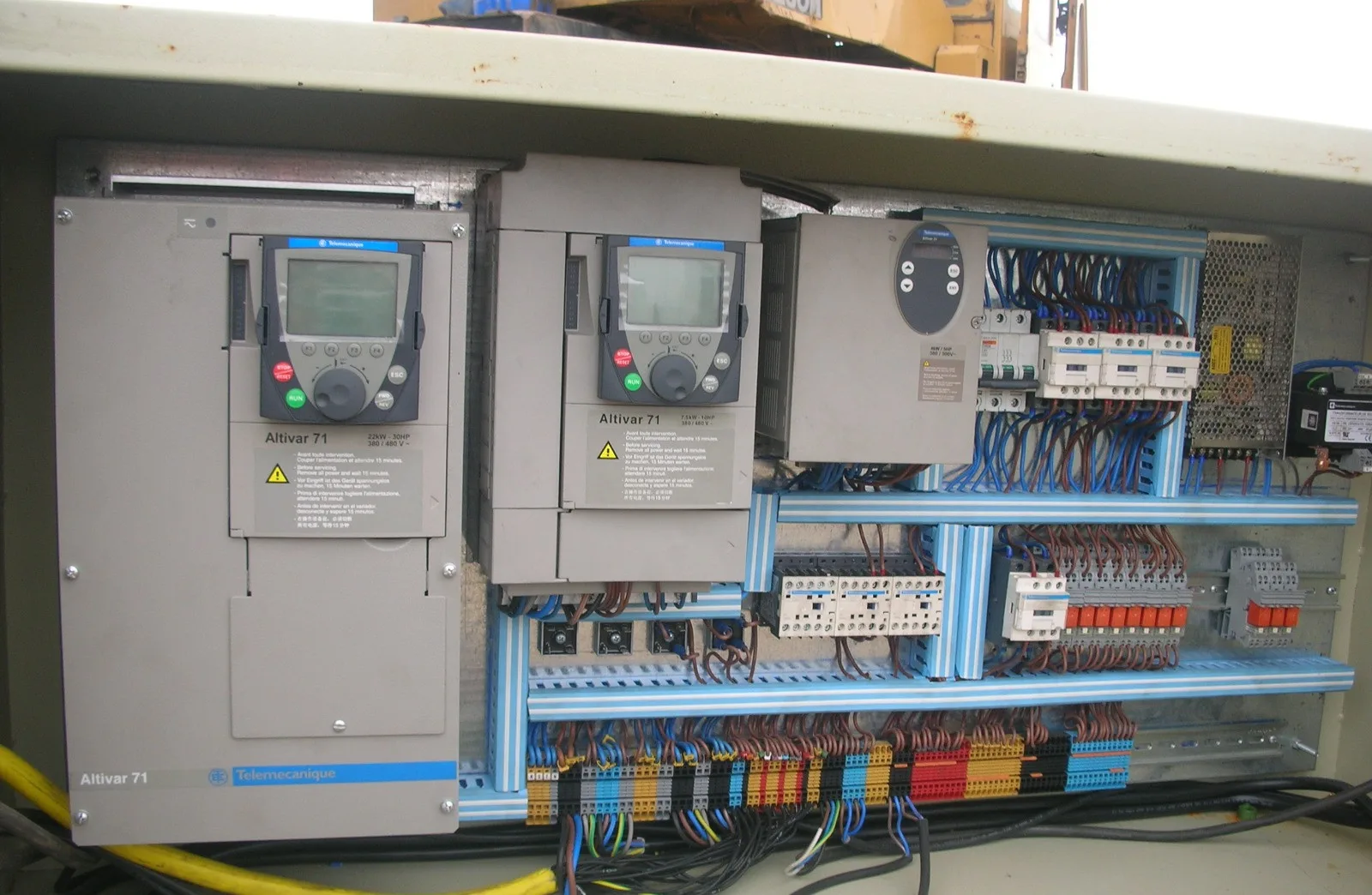
The electrical equipment is designed to EN 60204-32, typically with a crane disconnecting switch, mains contactor, short-circuit and overload protection and an emergency stop. Before shipping, the continuity of the protective bonding circuit, the insulation resistance and the control functions are verified.
Surface preparation and coating
A coating is only as good as the surface beneath it. Steel is usually blast-cleaned to a preparation grade such as Sa 2½ (ISO 8501-1), which removes mill scale and rust and gives the paint a profile to grip. The coating system of primer, intermediate coat and topcoat is then chosen for the corrosivity category of the site under ISO 12944.
Dry film thickness is measured and recorded. For outdoor cranes, ports and corrosive process areas, the options from heavy-duty paint systems to hot-dip galvanizing are compared in our article on outdoor crane corrosion protection.
Factory checks, packing and shipping
Before dispatch, the bridge is often pre-assembled to confirm span, diagonals and the fit of bolted joints, and the trolley is run and tested. Joints are match-marked so that the site team can reassemble them without guesswork. Typical checks and the records they produce:
| Stage | What is checked | Typical record |
|---|---|---|
| Materials | Grade, thickness, heat number | 3.1 certificate |
| Welding | Weld size, visual, NDT | Inspection report |
| Girders, bridge | Camber, sweep, diagonals | Dimensional report |
| Coating | Surface grade, film thickness | Coating report |
| Electrics | PE continuity, insulation, functions | Test report |
| Trolley, hoist | Brakes, limit switches, overload device | Function test record |
Packing depends on the route. Girders travel full length or in bolted sections, depending on transport limits; motors, panels and pendants are protected against moisture and impact, and machined surfaces are preserved. On site, the crane is installed, load-tested and commissioned; the sequence and the static and dynamic tests are explained in overhead crane installation and commissioning.
Manufacturing at Ervan Cranes
Design and steel fabrication stay in-house at the Ervan Cranes production facility in Torbalı, İzmir; the company was founded in 2003. Each crane is engineered to its load, span, lifting height and duty class, and other figures are determined per project. The team that designs a crane also commissions it on site. Read more on our manufacturing and engineering page and about our manufacturing and installation service.
The CE attestation of compliance ECP.25.02.C0045 covers our crane machinery models ERV05–RV50 under the Machinery Directive 2006/42/EC and the Low Voltage Directive 2014/35/EU. The overhead cranes we build range from 1 to 100 t.
Frequently Asked Questions
Which steel grades are used for crane girders?
Most crane structures use S235 or S355 to EN 10025-2, selected by the calculation. A higher grade does not automatically save weight, because the fatigue strength of welded details barely rises with yield strength. For low operating temperatures, the toughness quality (JR, J0, J2 or K2) must suit the plate thickness and the coldest service temperature.
Why do crane girders have a camber?
The camber offsets the deflection from the crane's own weight and part of the load, so the loaded girder lies roughly level. The trolley then does not have to climb out of a sag, and the hook stays where the operator expects it. Camber is built in during fabrication and measured before the crane leaves the works.
Which tests take place in the factory, and which on site?
The factory covers material, weld, dimensional and coating checks, plus electrical and function tests of the trolley and hoist. On site, after installation, limit switches and the overload device are set and the crane is load-tested: statically with at least 1.25 times and dynamically with 1.1 times the rated load (Machinery Directive 2006/42/EC, Annex I 4.1.2.3). Many countries also require an inspection before first use.
Can I inspect my crane during manufacturing?
Ask for this when you place the order. A common approach is an inspection and test plan with hold points, for example after girder welding and before painting, plus a factory acceptance before dispatch. Agree in advance which reports will be presented, so the visit compares measured values with the specification rather than impressions.
Build quality is easiest to judge on your own project. Tell us what you need to lift, where and how often, and we will prepare a technical offer showing how your crane would be engineered, built and tested. Start with our quote request form.