Standards & Regulation 7 min read
Overhead Crane Standards in Europe: EN 15011, EN 13001 and 2023/1230
Which laws and standards apply to an overhead crane in Europe and Türkiye: Machinery Directive and Regulation 2023/1230, EN 15011, EN 13001, the CE steps and inspections.
Ervan Cranes Engineering
Overhead crane standards in Europe sit under one legal framework: the Machinery Directive 2006/42/EC, which Regulation (EU) 2023/1230 replaces from 20 January 2027. EN 15011 is the product standard for bridge and gantry cranes, the EN 13001 series governs their design, and further standards cover hoists, controls and electrics. Operation is regulated separately by national rules.
Law, standard, national rule: what is mandatory?
Three layers apply to every crane, and they are often confused. Knowing which is which tells you what you can demand from a supplier and what remains your own duty as the operator.
- EU law (directive or regulation) sets the essential health and safety requirements a crane must meet before it is placed on the market. It is mandatory.
- Harmonized standards describe technical solutions. Applying them is voluntary, but a crane designed to a harmonized standard cited in the Official Journal of the EU is presumed to meet the requirements that standard covers.
- National operating rules address the employer: safe use, inspections and training. They apply for the whole life of the crane.
A manufacturer who deviates from a harmonized standard must prove by other means, such as calculations, tests and the risk assessment, that the crane is equally safe. That is legitimate but harder to verify, so look for the standards listed in the declaration of conformity.
Legal framework: from the Machinery Directive to Regulation (EU) 2023/1230
Machinery Directive 2006/42/EC
Until 19 January 2027, overhead cranes are placed on the EU market under Directive 2006/42/EC. Its Annex I lists the essential requirements, with a separate part on lifting hazards. Two examples: power-driven lifting machinery must withstand a static test with at least 1.25 times and a dynamic test with 1.1 times the rated load (4.1.2.3), and machinery with a rated load of 1 000 kg or more needs overload protection (4.2.2).
Machinery Regulation (EU) 2023/1230
From 20 January 2027, the Machinery Regulation applies instead. As a regulation, it applies directly in every member state without national transposition. For buyers, the core principle stays the same: the manufacturer assesses conformity, issues the declaration of conformity and affixes the CE marking. One practical change is that instructions for use may be supplied in digital form; if your team needs printed manuals, agree this in the contract.
What counts is the date the crane is placed on the market. A crane delivered and put into service under the Directive before that date keeps that basis; for projects handed over on or after 20 January 2027, ask which legal act the declaration will refer to. Under the Directive the document is called an EC declaration of conformity, under the Regulation an EU declaration of conformity.
Other directives and Türkiye
For the electrical equipment, the Low Voltage Directive 2014/35/EU (electrical safety) and the EMC Directive 2014/30/EU (electromagnetic compatibility, relevant for frequency inverters, for example) complement the machinery rules. Türkiye has transposed the Machinery Directive as the Makine Emniyeti Yönetmeliği, so the same CE approach applies to cranes placed on the Turkish market.
Overhead crane standards: the harmonized EN set
For an overhead crane, the following standards form the usual technical basis. EN 15011 is the product standard; it refers to the EN 13001 series for design and to separate standards for components and information for use.
| Standard | What it covers |
|---|---|
| EN ISO 12100 | General design principles, risk assessment and risk reduction |
| EN 15011 | Bridge and gantry cranes |
| EN 13001-1 | Crane design: general principles and requirements |
| EN 13001-2 | Crane design: load actions |
| EN 13001-3-1 | Proof of competence of steel structures |
| EN 14492-2 | Power-driven hoists |
| EN 13135 | Design of mechanical and electrical equipment |
| EN 12077-2 | Limiting and indicating devices |
| EN 13557 | Controls and control stations |
| EN 12644-1 / -2 | Information for use and testing: instructions, marking |
| EN 60204-1 / -32 | Electrical equipment: general, and for hoisting machines |
Further parts of EN 13001 deal with components such as wire ropes and wheel/rail contacts, and slewing jib cranes have their own product standard, EN 14985. Standards are revised over time, so ask which editions were applied.
Classification is a topic of its own: EN 13001 describes a crane's duty through load spectrum and number of working cycles, while FEM 9.511 and ISO 4301 groups such as 2m or M5 remain common in specifications. How these systems relate is explained in our article on crane duty classification.
CE marking of an overhead crane, step by step
CE marking is the end of a process, not a sticker. For an overhead crane, the manufacturer typically works through these steps:
- Risk assessment to EN ISO 12100: identify hazards in every phase of life, from installation to dismantling, and reduce the risks.
- Design to harmonized standards: structure, mechanisms, electrics and controls, including classification and calculations.
- Technical file: drawings, calculations, risk assessment, list of standards, test reports and instructions. The manufacturer keeps it available for the authorities; buyers do not normally receive it in full.
- Tests: functional checks and load tests, static with at least 1.25 times and dynamic with 1.1 times the rated load. As overhead cranes are usually assembled at the place of use, these tests normally take place on site after installation.
- Declaration of conformity signed by the manufacturer, naming the crane, the legal acts and the standards applied.
- CE marking on the crane, together with nameplate data such as the rated load.
- Instructions for use in the language of the country of use, covering operation, maintenance and inspection.
Installation and load testing are covered in detail in our article on overhead crane installation and commissioning. One point is often overlooked: whoever assembles a complete crane from bought-in components becomes its manufacturer in the legal sense and is responsible for this process.
In operation: inspections in the EU, Türkiye and Germany
Once the crane is in service, responsibility shifts to the employer. Directive 2009/104/EC on the use of work equipment requires inspections after installation and before first use, periodic inspections, and special inspections after exceptional events such as modifications, accidents or long periods of inactivity. National rules set the details:
- Türkiye: the İş Ekipmanlarının Kullanımında Sağlık ve Güvenlik Şartları Yönetmeliği follows the same approach and requires periodic inspection of lifting equipment by authorized persons at the intervals it sets, typically once a year.
- Germany: under the Betriebssicherheitsverordnung (BetrSichV), the employer defines the type, scope and intervals of inspections in the risk assessment; DGUV Vorschrift 52 requires cranes to be inspected at least once a year by a qualified person (Sachkundiger / befähigte Person).
Between inspections, operators check brakes, limit switches and other overhead crane safety devices at the start of each shift. An existing crane does not have to be upgraded every time a standard is revised, but it must be kept safe, and a substantial modification, such as raising the rated load, may have to be assessed like a new machine.
What buyers should request
Whether you buy in the EU, in Türkiye or for export, put these items into the purchase specification:
- The declaration of conformity for the specific crane (serial number), naming the legal act (2006/42/EC or, for hand-overs from 20 January 2027, Regulation (EU) 2023/1230) and the standards applied with their editions.
- CE marking and a nameplate showing the rated load.
- Instructions for use, maintenance and inspection in your language, printed or digital as agreed.
- Load test and commissioning records, including the settings of overload protection and limit switches.
- Electrical diagrams and a list of safety functions.
- Design data: classification (EN 13001 or FEM/ISO), rated load and the wheel loads your structural engineer needs for the runway.
- A spare parts list and the documents your inspector needs for the first inspection.
When you compare offers for overhead cranes, check that every supplier names the same standards and documents. A missing item is worth a question before you sign.
Conformity at Ervan Cranes
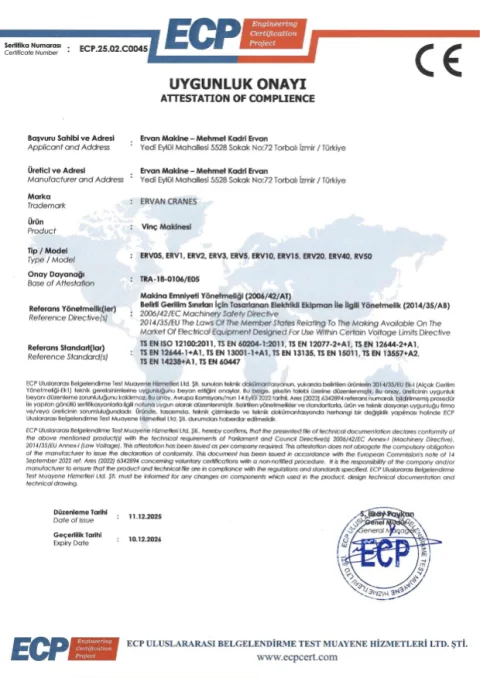
Ervan Cranes holds the CE attestation of compliance ECP.25.02.C0045, issued by ECP for the crane machinery models listed on it under the Machinery Directive 2006/42/EC and the Low Voltage Directive 2014/35/EU. The reference standards listed on it, as TS EN editions, are EN ISO 12100, EN 60204-1, EN 12077-2, EN 12644-1, EN 12644-2, EN 13001-1, EN 13135, EN 15011, EN 13557, EN 14238 and EN 60447.
This attestation was issued under a voluntary, non-notified procedure and does not replace the manufacturer's declaration of conformity. You can view the document on our website, and our article What our CE attestation means explains it in detail.
Frequently Asked Questions
Is CE marking mandatory for an overhead crane in the EU?
Yes. A power-driven overhead crane is machinery under the Machinery Directive and, from 20 January 2027, under Regulation (EU) 2023/1230. It may only be placed on the market or put into service with a declaration of conformity, CE marking and instructions for use. In Türkiye, the Makine Emniyeti Yönetmeliği sets the same requirement.
What changes with Regulation (EU) 2023/1230?
For buyers, the CE principle stays the same: the manufacturer assesses conformity, signs the declaration and marks the crane. Instructions may be supplied digitally, and the legal reference in the declaration changes for cranes placed on the market from 20 January 2027. Clarify early with your supplier how a project close to that date will be handled.
Does an old crane need to comply with new standards?
Not automatically. A crane must meet the rules that applied when it was placed on the market and be kept safe through maintenance and inspection. Substantial modifications or findings from the employer's risk assessment can, however, require upgrades.
Who performs periodic inspections?
In Türkiye, authorized persons as defined under the İş Ekipmanları Yönetmeliği, typically once a year for lifting equipment. In Germany, a qualified person at least once a year under DGUV Vorschrift 52 and BetrSichV. The crane manufacturer can carry out maintenance, but the employer remains responsible for having the inspections done.
Send us the load, span, lifting height, duty and country of use of your crane, and we will clarify with you which standards and documents apply to it. Request a quote to get started.