
Maintenance & Safety 8 min read
Overhead Crane Wear Parts: What to Check and When to Replace
Wire rope, sheaves, hook, brakes, wheels, gearboxes and electrical parts: what to inspect on each overhead crane wear part, when it is due for replacement and which spares to stock.
Ervan Cranes Engineering
Wire rope, rope drum and sheaves, hook, brake linings, wheels, couplings, buffers, current collectors and contactors are the overhead crane wear parts that normal operation consumes. Each is replaced by condition, not by calendar – against the ISO 4309 discard criteria for ropes and the manufacturer's limits for everything else, measured and recorded at every inspection.
Why overhead crane wear parts are replaced by condition
How fast a part wears depends less on its age than on how the crane is used. The duty class – load spectrum combined with running time or number of cycles – sets the design life of the mechanisms. The real wear rate follows from the environment, runway alignment, lubrication and operating habits such as inching, side pulling or reversing at speed.
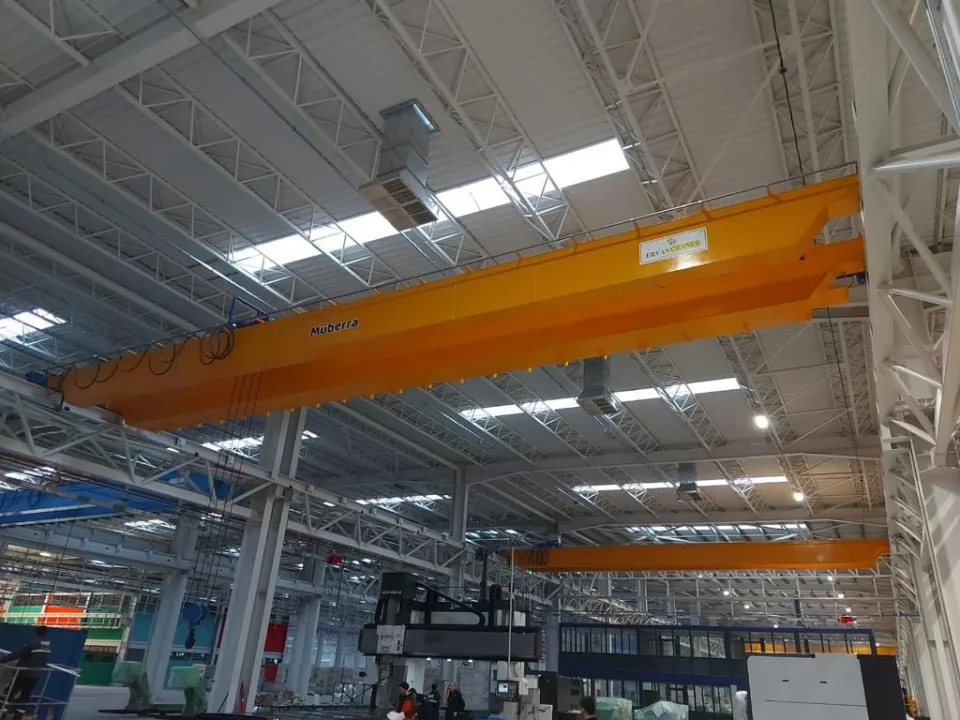
A fixed replacement calendar therefore either throws away good parts or misses worn ones. Condition-based replacement needs three things: a defined limit for each part, a measurement at every inspection and a record that shows the trend. Daily pre-use checks by the operator and periodic inspections by a competent person, as described in our periodic maintenance checklist, supply the data. Where each part sits in the crane is explained in overhead crane components.
Wire rope: discard criteria under ISO 4309
The wire rope leaves the least room for error. ISO 4309 defines when a crane rope has reached discard state: it is replaced as soon as one criterion is met, or when several moderate findings together reach that point. The main wire rope replacement criteria are:
- Visible broken wires: their number over the reference lengths defined in the standard, clusters in one strand or section, breaks in the valleys between strands and at the termination.
- Strand fracture: a broken strand means immediate discard.
- Diameter reduction: judged against the reference diameter recorded once the new rope has bedded in; a local reduction often points to core damage.
- Corrosion: pitting and slack outer wires; dry, reddish dust between the strands signals internal corrosion.
- Deformation: kinks, birdcaging, waviness, core or strand protrusion, flattening from crushing on the drum.
- Heat or arc damage: discoloured wires or welding spatter from earth faults.
ISO 4309 treats rotation-resistant ropes separately, with their own broken-wire limits, and ropes running over synthetic sheaves can deteriorate internally before many external breaks become visible. Inspect the full length, paying particular attention to the sections that pass over sheaves most often, the area at the compensating sheave and both terminations.
Replacing a rope correctly
The new rope must match the original specification: diameter, construction, rotation-resistant or not, lay direction, wire grade and minimum breaking force. Install it without twisting it, run it in with light loads as the rope maker recommends and record the new reference diameter.
Rope drum, sheaves and hook block
Drum and sheaves
Grooves gradually wear to the profile of the rope. A groove that has become too narrow pinches a new rope, and a corrugated one stamps its pattern into it. Check groove profiles with a gauge, look for chipped flanges and cracks, and make sure every sheave turns freely – a seized sheave grinds the rope flat in a short time. On many wire rope hoists the rope guide on the drum is a wear part too and should be checked whenever the rope is changed.
Hook and hook block
The hook is checked for widening of the throat opening, twisting, wear at the saddle where slings bear, cracks and corrosion. Some hooks carry reference marks for measuring the opening; otherwise, record a reference measurement at commissioning and compare later readings with the manufacturer's limit. The safety latch must close by itself, the hook must turn freely on its thrust bearing and the hook nut must be secured. A hook is never repaired by welding or heating – if it is deformed or cracked, it is replaced.
Brakes: lining wear and air gap
Most hoist and travel brakes on overhead cranes are spring-applied and released electrically, so they close when the power fails. On the common electromagnetic disc brake, the air gap between armature plate and magnet body grows as the lining wears. Beyond the manufacturer's maximum, the brake may no longer release cleanly or may lose holding torque. Measure the air gap with feeler gauges at every inspection, readjust it where the design allows and replace the lining or rotor once it reaches minimum thickness.
Warning signs between inspections are a longer stopping distance, a load that creeps down after stopping, a burning smell, squealing or an unusually hot brake housing. The hoist brake is a safety function – see our article on overhead crane safety devices.
Crane wheel wear and rails
Crane wheel wear shows on the tread, whose diameter shrinks, and on the flanges, which become thin or sharp-edged. Driven wheels matter most. If their diameters differ, the two ends of the bridge travel at slightly different speeds, the crane runs skew and the flanges rub against the rails, which wears them further. Skewing is therefore both a symptom and a cause.
- Measure tread diameters and flange thickness and compare them with the manufacturer's limits.
- Replace driven wheels as a matched set so that their diameters stay equal.
- Look for shiny or worn rail edges, metal shavings on the rail and squealing during travel.
- When wear appears on one side only, have the rail fixings, joints and runway geometry checked.
Gearboxes, couplings, buffers and electrical parts
Gearboxes and hoist mechanisms
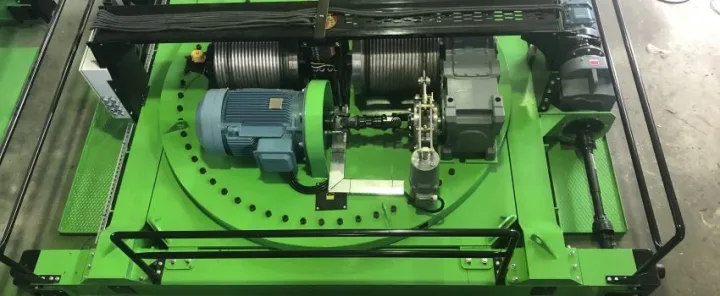
Check the oil level and look for leaks at every inspection, and change the oil at the interval the manufacturer specifies. Metal particles in the oil, rising temperature, new noises or growing backlash indicate worn gears or bearings; investigate before the damage spreads. For serial hoists, manufacturers often define a theoretical service life based on the duty class (safe working period, FEM 9.755); once it is used up, a general overhaul is due.
Couplings and buffers
Elastic coupling elements harden and crack, and a knock when starting or stopping often points to them. Gear couplings need lubrication. Elastomer buffers are replaced when they are cracked or permanently compressed, hydraulic buffers when they leak. After a hard impact against the end stops, inspect the buffers and the structure around them.
Power supply and controls
Current collector carbons wear down to their marked limit, festoon trolley rollers wear and flat cables crack where they bend. On contactor-controlled cranes with frequent inching and reversing, contactors wear fastest; pitted or welded contacts are replaced as a set. On the pendant, check the push buttons, cable, strain relief and emergency stop; on radio remotes, the battery capacity and keypad.
Load chain on chain hoists
A load chain lengthens as the links wear at their contact points. Measure the pitch elongation over several links with a gauge and compare it with the manufacturer's limit. Inspect the load sprocket and chain guide as well, because a new chain on a worn sprocket wears quickly, and use only the chain specified by the hoist manufacturer – it has to match the sprocket exactly.
Replacement criteria at a glance
| Part | What to check | Replace when |
|---|---|---|
| Wire rope | Broken wires, diameter, corrosion, deformation | An ISO 4309 discard criterion is reached |
| Drum, sheaves | Groove profile, flanges, bearings | Groove worn past limit, cracks, seized bearing |
| Hook | Opening, saddle wear, twist, latch | Manufacturer's limit exceeded or any crack |
| Brake | Lining thickness, air gap, holding | Minimum lining reached or load slips |
| Wheels | Tread diameter, flange thickness | Wear limit reached or diameters unequal |
| Gearbox | Oil, leaks, noise, backlash | Gear or bearing damage; overhaul due |
| Couplings, buffers | Elastic elements, cracks, leaks | Cracked, hardened, compressed or leaking |
| Collectors, cables | Carbon wear, insulation | Wear mark reached, insulation damaged |
| Contactors | Contact surfaces | Pitted, sticking or welded contacts |
| Load chain | Pitch elongation, link wear | Manufacturer's elongation limit reached |
Building a spare-parts strategy
The aim is simple: no crane should stand idle for days because a small part has to be sourced. Rate each part by its safety relevance, by the impact of a breakdown – a single crane feeding a production line is critical – and by how quickly it can be procured. Parts that score high on two of the three belong on your shelf:
- Brake linings or a complete brake, plus a brake rectifier
- A set of contactors and relays, fuses and a limit switch
- Pendant switch elements or a spare pendant; radio batteries and a charger
- Current collectors and festoon trolleys
- For critical cranes: a wire rope to the exact specification and a set of travel wheels
Order crane spare parts using the data on the crane and component nameplates, the serial number and the original part numbers; for ropes, quote the full specification. Log every measurement and every replacement. After two or three inspections, the trend shows which part is next and justifies the stock you hold.
How Ervan Cranes supports maintenance teams
Ervan Cranes supplies spare parts for overhead cranes: wheels, wire ropes, hook blocks, brakes and control components. Our maintenance and technical support covers periodic maintenance, breakdown response and operator training. Design, steel fabrication, commissioning and technical support belong to one workflow, and the overhead cranes we manufacture are designed and commissioned by the same team.
Frequently Asked Questions
How often should the wire rope be replaced?
No calendar interval applies: the rope is replaced when it reaches discard state under ISO 4309. That makes regular inspection essential – a daily visual check by the operator and a thorough examination by a competent person at each periodic inspection.
Can I use non-original parts?
Only if they match the original specification in every safety-relevant property – dimensions, material, strength, braking torque or rope construction – and come with documentation. For safety-critical parts such as ropes, hooks and brakes, a deviation can amount to a modification of the crane that needs a fresh assessment. If in doubt, ask the crane manufacturer.
Which spare parts should be kept in stock?
At a minimum, the parts whose failure stops the crane and that cannot be sourced quickly: brake parts, contactors, limit switches, pendant or radio spares and current collectors. Cranes that production cannot do without justify a spare rope and travel wheels.
Why do crane wheels wear on one side?
One-sided flange wear means the crane runs skew. Typical causes are unequal driven-wheel diameters, misaligned rails, a span that varies along the runway and uneven starting or braking of the drives. New wheels only last if the cause is fixed.
If a part on your crane is close to its limit, complete data is the quickest route to the right replacement: nameplate details, photos and your inspection findings. Request a quote for wear parts with that information, and we will offer the matching components.

