Technical Guides 9 min read
Jib Crane vs Overhead Crane: Differences and How to Choose
Jib crane vs overhead crane: how they differ in working area, installation and building loads, capacity, workflow and outdoor use, what drives the cost, how they work together, plus a decision checklist.
Ervan Cranes Engineering

Jib crane vs overhead crane: the choice comes down to the area the hook must serve. A jib crane slews around a pillar or wall bracket, lifting within a circle at one workstation. An overhead crane runs on a runway and covers the whole rectangular bay. Jib cranes suit repetitive lifts at one station; overhead cranes move loads through the hall. The two are often used together.
What is the difference between a jib crane and an overhead crane?
On a jib crane, the hoist travels along a horizontal arm (boom) that slews around a pillar or a wall bracket. It has three motions – hoisting, hoist travel along the arm and slewing – and is always tied to one fixed point. Depending on the mounting, it is a pillar jib crane or a wall-mounted jib crane.
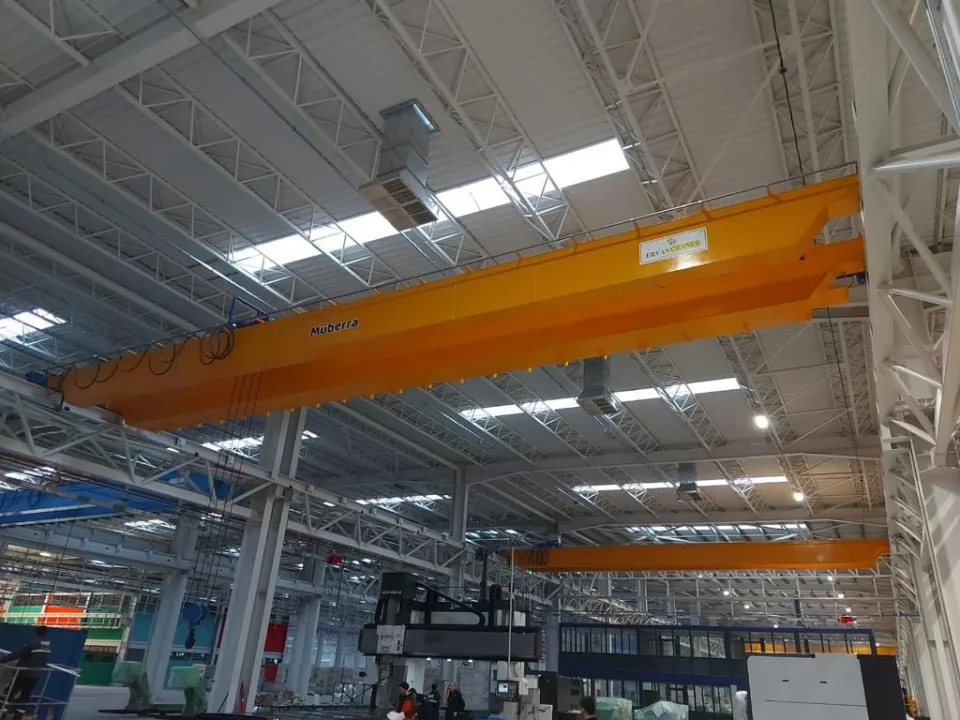
On an overhead crane, a single or double girder bridge travels on runway rails along both sides of the bay, a trolley crosses the bridge and the hoist raises and lowers the load. How it works and what it is made of is explained in what is an overhead travelling crane; the other crane types are compared in types of industrial cranes.
Working area: circle or rectangle?
The hook of a jib crane stays within the working radius set by the arm length: a full circle for a pillar crane, a sector for a wall-mounted one. Because the hoist cannot travel right up to the pillar, a small dead zone remains around it. The area covered grows with the square of the radius, but a longer arm also increases the moment on the pillar and foundation.
An overhead crane works within the rectangle formed by its span and runway length, minus narrow strips along the walls and ends that the hook cannot approach. One overhead crane reaches every machine along a production line. With jib cranes, each station has its own circle; a load only passes to the next station where circles overlap, after being set down and re-slung.
Jib crane vs overhead crane at a glance
| Criterion | Jib crane | Overhead crane |
|---|---|---|
| Working area | Circle around the pillar or sector in front of the wall | Rectangular area of the bay along the runway |
| Supporting structure | Pillar type on its own foundation, no load on the building; wall type on a building column or wall | Runway; wheel loads and horizontal forces go into building columns and foundations |
| Floor space | Pillar type needs a small footprint; wall type none | Floor stays completely clear |
| Capacity | Capacity and working radius are set together per project | Engineered to capacity, span, lifting height and duty class |
| Typical tasks | Machine and workbench loading, assembly and maintenance stations, loading points | Transport between stations, material flow along the hall, long and heavy loads |
| Availability | Dedicated to its station; no waiting for the hall crane | One crane serves many stations; queues form at peak times |
| Outdoor use | On quays, jetties and loading points with suitable surface protection | Needs an outdoor runway; open yards usually get a gantry crane instead |
| Expansion | A new station needs a new jib crane | Runway can be extended within the building; a second crane can share it |
| European product standard | EN 16851 (pillar and wall-mounted, no cabin, up to 10 t and 500 kNm) | EN 15011 (bridge and gantry cranes) |
Installation: foundation, wall or runway?
Pillar jib crane
The pillar transfers the overturning moment from the load and the arm into the floor through anchor bolts. It therefore stands either on its own concrete foundation or on an existing floor slab that a structural engineer has checked for this load. Because it puts no load on the building columns or roof, it is also an option in halls without a runway or not designed for crane loads.
Wall-mounted jib crane
The bracket is fixed to a load-bearing building column or a reinforced concrete wall, so the crane takes up no floor space. In return, that column or wall must carry the additional bending moment and horizontal forces, which the building's structural engineer has to verify. With the wall behind the arm, the slewing range is limited by the wall and the surrounding structure.
Overhead crane and runway
An overhead crane needs a runway along both sides of the bay: runway girders, rails, end stops and a power supply line. Wheel loads plus the horizontal forces from braking and skewing go into the building columns and foundations, so an existing building needs a structural check. Responsibilities and a checklist are covered in our article on crane runway requirements.
How are capacity and working radius determined?
Neither crane has a "typical" capacity; the values follow from the load and the task. On a jib crane, capacity and working radius are set together, because the governing quantity is the moment – load multiplied by radius, plus the weight of the arm and hoist. With the same pillar and foundation, a longer arm means a lower capacity. Deflection at the arm tip also affects how precisely loads can be placed.
Most jib cranes carry an electric chain hoist; a wire rope hoist is chosen for higher capacities, greater lifting heights or intensive duty. The selection criteria are compared in wire rope hoist vs chain hoist. For an overhead crane, capacity, span, lifting height and duty class are considered together.
Lifting at a workstation or moving loads through the hall?
A jib crane is made for work concentrated at one point: loading machine tools and workbenches, assembly stations, maintenance stations or loading points. Because it belongs to the station, operators lift when they need to, and the short hook path saves time in repetitive cycles. Light loads are usually slewed by hand, while heavier ones may call for a powered slewing drive.
An overhead crane moves loads between stations, from goods-in through production to dispatch. It reaches every point of the bay but handles one load at a time, so when several stations need it at once, waiting times build up. If moving loads at floor level is also an option, see our comparison forklift vs overhead crane.
Jib cranes in a hall with an overhead crane
Jib cranes provide independent lifting at points the overhead crane cannot reach or where it is constantly busy. When combining the two, plan the following from the start:
- The pillar head and arm of the jib crane must stay a safe distance below the overhead crane's bridge, trolley and fully raised hook block.
- That height limit also sets the jib crane's own hook height, so check it against the load and sling lengths.
- If a wall-mounted jib crane goes on a column that also carries the runway, check the column for both cranes' loads together.
- Define in writing how the overhead crane carries loads over the jib area and which crane has priority.
Which crane works outdoors?
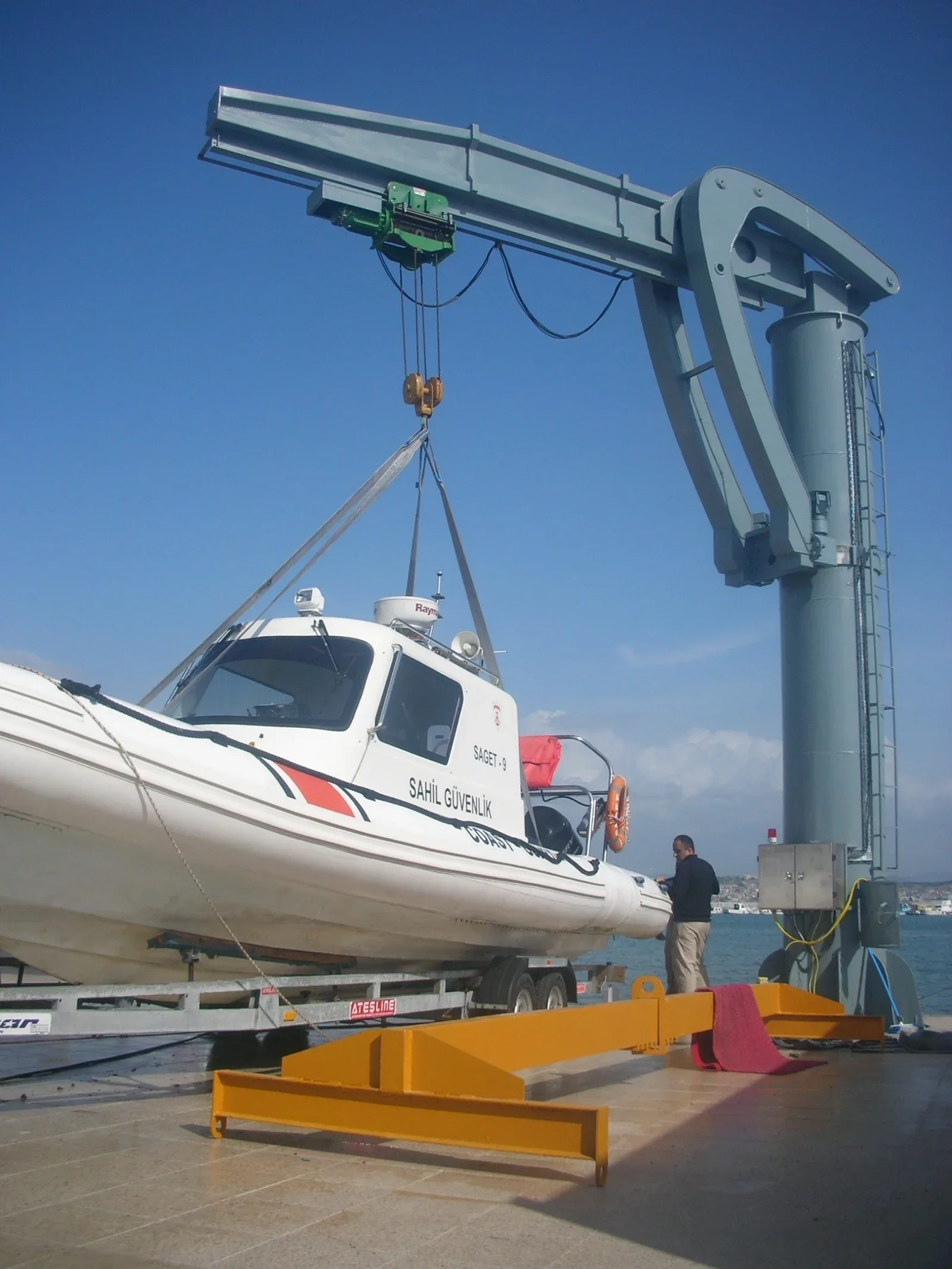
Jib cranes also work outdoors; quays, marinas, jetties and loading points are typical examples. The steel structure then gets surface protection suited to the site, such as hot-dip galvanizing; the electrical equipment is selected for outdoor conditions and wind loads are included in the design.
To use an overhead crane outdoors, you usually need a runway on its own columns, and wind calculation and storm securing come on top. That is why open stockyards without a building usually get a gantry crane instead; the two options are compared in overhead crane vs gantry crane.
What drives the cost?
Comparing crane prices alone is misleading; compare the complete solution, including foundations, building work, installation and operation. The main drivers are:
- Jib crane: the moment created by capacity and working radius, which sizes the pillar, arm and foundation; a new foundation or anchoring into an existing slab; for wall-mounted cranes, checking and, if necessary, strengthening the column; the hoist; manual or powered slewing; galvanizing for outdoor use.
- Overhead crane: capacity, span, lifting height and duty class; an existing or new runway; the power supply line; building reinforcement where needed; controls and installation.
- Number of stations: each jib crane serves one station; where loads travel between many stations, one overhead crane can be the more sensible overall solution.
The cost items of an overhead crane are explained in detail in overhead crane cost factors.
Ask which design standard applies
The European product standard for bridge and gantry cranes is EN 15011. Pillar and wall-mounted jib cranes without an operator's cabin, with a rated capacity of up to 10 t and an overturning load moment of up to 500 kNm, fall under EN 16851, the standard for light crane systems. EN 14985, which covers slewing jib cranes, explicitly excludes pillar and wall-mounted jib cranes from its scope. Ask in writing which standard the crane in your quotation is designed to.
Decision checklist: which crane do you need?
A jib crane is probably the right choice if:
- lifting is concentrated at one station, around a fixed point;
- loads do not travel between stations and the work area fits within a circle;
- there is no runway in the hall and installing one is not possible or not worthwhile;
- the overhead crane is constantly busy or cannot reach the station;
- you need point lifting outdoors at a quay, jetty or loading point.
An overhead crane is probably the right choice if:
- loads move along the hall and between stations;
- loads are heavy, long or bulky and the area to cover does not fit within a circle;
- the floor must stay completely clear;
- the building can carry a runway, or a new runway can be planned.
If you answer yes to both lists, the answer is most likely a combination: an overhead crane for the main flow and jib cranes at the stations.
How Ervan Cranes can help
Founded in 2003, Ervan Cranes designs and builds both product groups at its facility in Torbalı, İzmir, Türkiye. Our jib cranes are built as pillar jib cranes with 360° slewing, with wall-mounted versions by project; capacity and working radius are determined per project. They are suitable for indoor and outdoor use, with a hot-dip galvanized option for marine and outdoor settings, and the product page shows reference projects such as a galvanized jib crane installation and a marine jib crane. Our single and double girder overhead cranes cover 1–100 t.
In project design we select the crane by load, span, lifting height and duty class, assess the runway and building interaction, and prepare technical drawings and a calculation report. The steel structure and hoist units are fabricated at the Torbalı facility, followed by site erection, adjustment, load test and commissioning. Not sure which system fits? In the quote form, choose "Other / not sure" as the product and attach a layout sketch. Technical details are optional; leave unknown fields blank and our engineering team will clarify them with you.
Frequently Asked Questions
How far does a jib crane slew?
A pillar jib crane can slew up to 360° around its pillar; Ervan Cranes designs its pillar jib cranes for 360° slewing. On a wall-mounted jib crane, the wall behind the arm and nearby structural members limit the slewing range, so the arm sweeps a sector in front of the wall. The actual angle is set per project, based on the connection detail and surrounding obstacles.
Does a jib crane need a foundation?
A pillar jib crane does: the pillar transfers the overturning moment into the floor through anchor bolts. Either a dedicated concrete foundation is built, or a structural engineer verifies that the existing slab can take the moment; capacity, working radius and ground conditions set the size. A wall-mounted jib crane needs no foundation, but its column or wall must be checked for the additional loads.
Can a jib crane be used in a hall with an overhead crane?
Yes, this is a common layout. Jib cranes give independent lifting at stations the overhead crane cannot reach or where it is constantly busy, leaving it free for transport between stations and heavy lifts. The jib arm must stay a safe distance below the overhead crane's bridge, trolley and hook block, and both cranes' working zones and priority rules should be defined in advance.
Can a jib crane be used outdoors?
Yes. Quays, marinas, jetties and loading points are typical outdoor applications. Outdoors, the steel structure needs surface protection suited to the site's corrosion conditions, such as hot-dip galvanizing; the electrical equipment must be protected against the weather, and wind loads must be included in the design. Ervan Cranes offers its jib cranes with a hot-dip galvanized option for marine and outdoor settings.
Which is more economical: a jib crane or an overhead crane?
It depends, so compare the complete solution – foundations, building work, runway and installation – rather than crane prices alone. For a single station, a pillar jib crane involves fewer cost items, because it needs no runway, no runway conductor line and no building reinforcement – only a power feed to the pillar. Where loads travel between many stations, one overhead crane can be a more sensible investment than a separate jib crane at every station.