
Technical Guides 8 min read
Variable Frequency Drives on Overhead Cranes: Benefits and Limits
What a variable frequency drive changes on an overhead crane: soft starts, less load swing, precise positioning and lower wear – plus hoist brake logic, braking energy, retrofits and limits.
Ervan Cranes Engineering
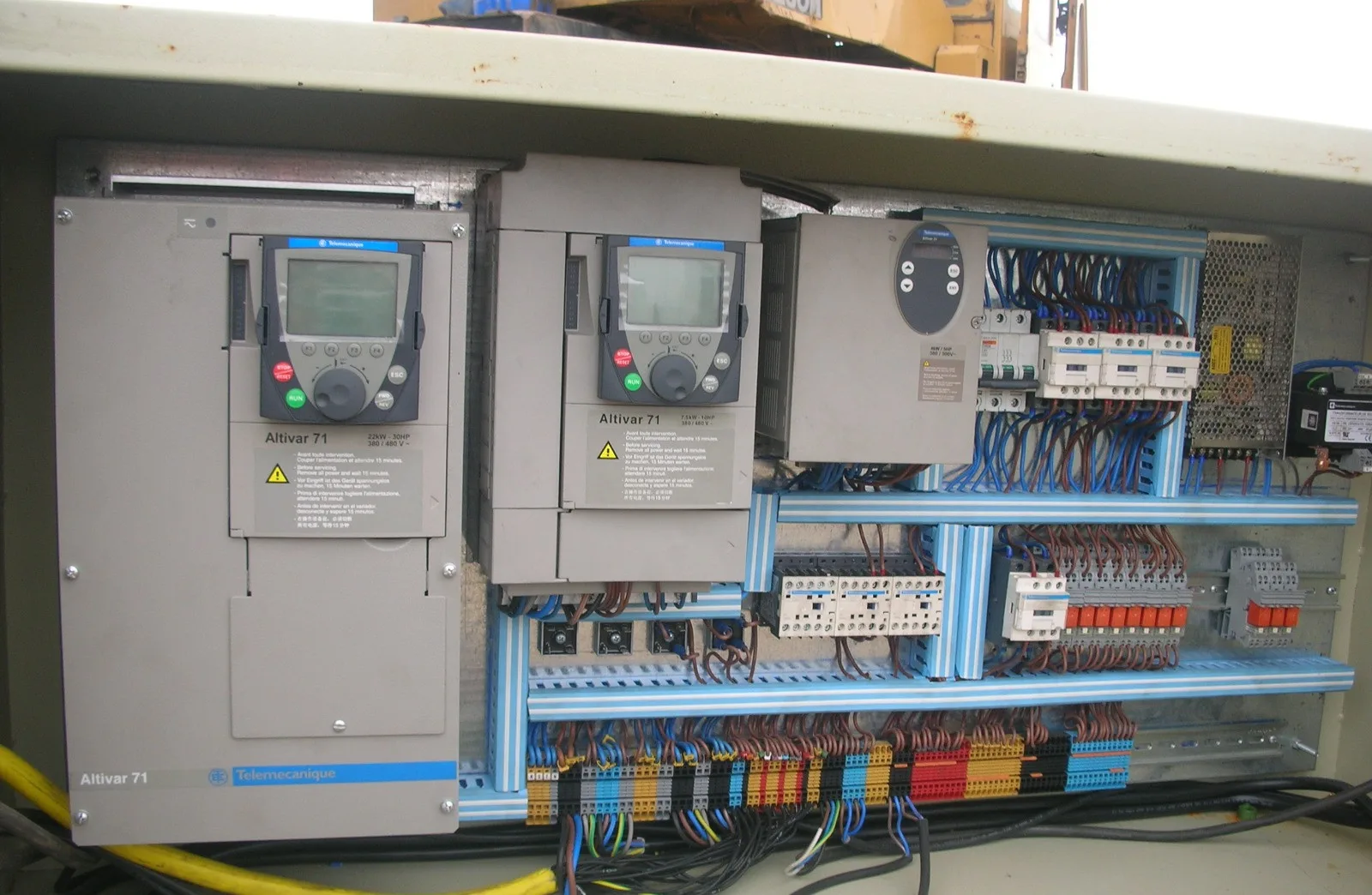
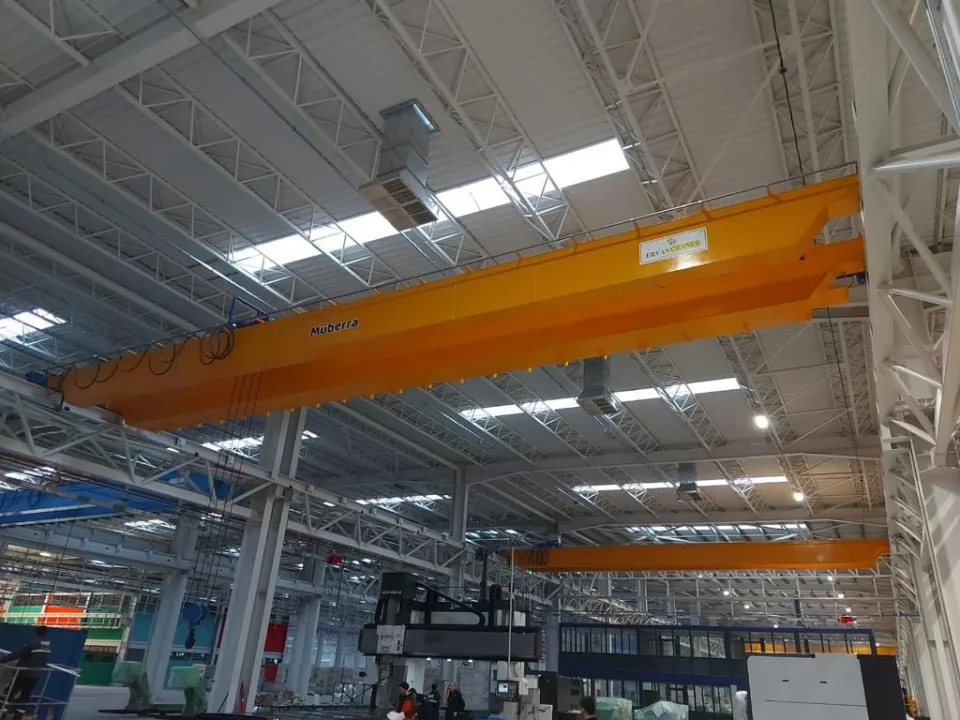
A variable frequency drive (VFD) on an overhead crane controls motor speed through the supply frequency, so every motion starts and stops along an adjustable ramp instead of jumping between fixed speeds. Done properly, it means less load swing, finer positioning and less wear on brakes, gearboxes and wheels.
How does a variable frequency drive work on an overhead crane?
The speed of an induction motor follows the frequency of its supply. A VFD – also called a frequency inverter – rectifies the mains voltage into a DC link and then switches it with power semiconductors into a new three-phase output whose frequency and voltage can be varied. The crane control sends a speed command, and the drive turns it into smooth, stepless speed control.
The conventional alternative is the pole-changing motor. Two separate windings, or a Dahlander connection, give one fast and one slow speed, and contactors switch between them. Every switch-over is a torque step: the crane jerks into motion, the load swings at the change to slow speed, and each direct-on-line start draws a multiple of the motor's rated current.
| Criterion | Pole-changing motor | Frequency inverter |
|---|---|---|
| Speeds | Two fixed steps | Stepless within a set range |
| Start | Abrupt, high inrush current | Ramped, current limited |
| Load swing | At every speed change | Low; anti-sway optional |
| Stopping | Brake stops the motion | Motor decelerates, brake holds |
| Positioning | Inching on slow speed | Fine creep speed |
| Initial cost | Lower | Higher |
| Servicing | Simple contactor logic | Needs parameter know-how |
What a VFD changes in daily crane operation
- Soft acceleration and deceleration. Ramp times are matched to the crane: long enough to avoid jerks and wheel slip, short enough to keep cycle times productive.
- Less load swing. Smooth ramps already reduce pendulum motion. Optional anti-sway functions go further: they use the rope length, known from the hook position, to shape the acceleration so that the swing is largely cancelled out.
- Precise positioning. A low creep speed lets operators set down moulds, machine parts or coils gently and exactly. Radio remotes with proportional joysticks give fully stepless control, and on a two-step pendant an ‘electronic potentiometer’ mode can hold any speed in between – see our guide to overhead crane controls.
- Less mechanical wear. When the drive brings the motion to almost zero speed before the brake closes, the brake mostly holds instead of stopping. Gearboxes, couplings, wheels and the runway see fewer torque peaks, which pays off in the condition of the overhead crane wear parts.
- Lower starting current. The drive limits current during acceleration, which reduces voltage dips on the conductor line and in the plant network – relevant when choosing the crane power supply.
Hoist drives and travel drives: not the same task
Travel drives
For long travel and cross travel, the ramps are the main gain. One inverter often feeds both long-travel motors of the bridge; each motor then needs its own overload protection. Ramp times and limit switches must be coordinated: a longer deceleration ramp means a longer stopping distance, so slowdown switches must trip early enough ahead of the final limits and end stops.
Hoist drives
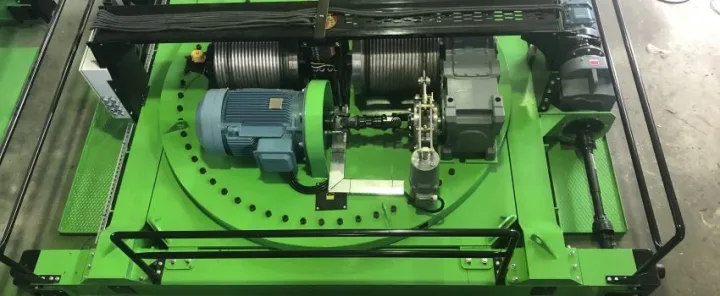
An inverter-controlled hoist has to hold the load at zero speed. When starting, the drive magnetizes the motor and builds up torque before the brake is released; when stopping, it brings the load to a standstill, the brake closes, and only then is the torque removed. If this sequence is set wrongly, the load dips briefly at start-up – a sign that the parameters must be checked at once.
Hoists therefore typically run with vector control, often with an encoder for speed feedback, plus monitoring such as overspeed and brake-slip detection. Where the crane is designed for it, light loads can be lifted faster than nominal speed. The drive is sized for the duty and the peak torque during acceleration, not just for the motor nameplate – the background is explained in crane duty classification.
Braking energy: resistor or regenerative unit?
When a load is lowered or a travel motion decelerates, the motor works as a generator and pushes energy back into the drive's DC link. That energy has to go somewhere:
- Braking resistor: a brake chopper switches the surplus energy into a resistor, which turns it into heat. Simple and widespread – but the resistor must be sized for the real lowering duty and mounted where its heat can dissipate safely, protected from rain outdoors.
- Regenerative unit: an active front end feeds braking energy back into the mains, where other consumers can use it. It costs more and adds complexity; it pays off mainly on hoists with high duty and long lowering distances, and it needs a reliable supply connection while braking.
With several inverters, a common DC bus lets one motion use another's braking energy – the bridge accelerating while the hoist lowers, for example.
Practical points: cooling, EMC, parameters and diagnostics
- Panel cooling: inverters produce heat. The panel needs adequate ventilation or cooling, dust filters and, in unheated halls or outdoors, anti-condensation heating. Near furnaces or under a hot roof, the ambient temperature can exceed the drive's rating, so derating or active cooling must be planned.
- EMC: the switched output causes high-frequency interference. Shielded motor cables bonded over a large area at both ends, a sound earthing concept and separate routing of power and control lines keep it in check. A motor cable running through the festoon must be a shielded, festoon-rated type; long motor cables may need output filters to protect the winding insulation.
- Parameters: ramps, speed limits, brake timing and motor data are stored as parameters. Keep a backup and a written parameter list, and let only qualified staff make changes, with a record of each one. A replacement drive must receive exactly the same settings.
- Diagnostics: the fault log records events such as overcurrent, DC-link overvoltage (often a braking resistor problem or a ramp set too short), undervoltage (supply or current collector problems), overtemperature or encoder faults. Reading it is usually the fastest way to the cause of a breakdown.
Can an existing crane be retrofitted with VFDs?
In many cases, yes – but only after an assessment of the crane as it is today. A conversion touches several assemblies at once:
- Motors: is the winding insulation suitable for inverter supply, and is cooling sufficient at low speed? Self-ventilated motors cool less when they run slowly; a separate fan may be needed.
- Brakes: can the brake be controlled by the drive's brake logic, and are linings and air gap in order?
- Control panel: space, heat dissipation and a safe mounting place for the braking resistor.
- Cabling: shielded motor cables and enough capacity in the festoon or conductor line.
- Limit switches: positions checked against the new ramps and stopping distances.
- Control station: a pendant or radio remote that supports stepless control.
- Documentation: updated circuit diagrams, a parameter list and a revised risk assessment.
A drive retrofit changes safety-related functions, so the crane must be tested and inspected by a competent person before further use. National work-equipment rules – the İş Ekipmanları Yönetmeliği in Türkiye, BetrSichV and DGUV Vorschrift 52 in Germany – provide for an inspection after modifications that can affect safety.
Limits – and what to specify in your enquiry
A crane VFD has drawbacks too. It costs more than contactor control, needs maintenance staff who can read fault logs and handle parameters, and is sensitive to heat, dust and humidity if the panel is not designed for them. A failed drive stops its motion, so plan how a replacement unit and the parameter backup will be available.
If you want VFDs on a new crane, define these points in the enquiry:
- which motions need a drive – hoist, cross travel, long travel;
- the required speeds and the slowest positioning speed;
- the control station: pendant, radio remote or cab;
- whether anti-sway or other assist functions are needed;
- the braking energy concept: resistor or regenerative unit;
- ambient conditions: temperature range, dust, humidity, indoors or outdoors;
- the documentation you expect: parameter list, circuit diagrams, fault-code list and training for your maintenance team.
How Ervan Cranes approaches drive selection
At Ervan Cranes, the drive concept is part of the technical design, not an accessory added at the end. Each crane is engineered to its load, span, lifting height and duty class, and the drive and control concept for hoisting and travel is determined per project on that basis. The steel structure is fabricated at our facility in Torbalı, İzmir; the same team that designs the crane installs, load-tests and commissions it.
After handover, our maintenance and technical support covers periodic maintenance, breakdown response and operator training, and control components are part of our spare parts service. The range is shown under our single and double girder overhead cranes.
Frequently Asked Questions
Does a VFD save energy on an overhead crane?
Some, but that is rarely the main reason to install one. Lifting a load needs the same energy either way; savings come from avoiding high starting losses and, with a regenerative unit, from returning braking energy to the network – with a braking resistor, it ends up as heat. The decisive benefits are control quality and less wear.
Does the frequency inverter replace the mechanical brake?
No. The spring-applied holding brake remains a safety element: it holds the load at standstill and must stop the motion if the power fails, an emergency stop is pressed or the drive trips. Safe Torque Off only removes motor torque – on a hoist, that is safe only together with a brake that holds the load. In normal operation the brake now closes at near-zero speed, so linings last longer, but lining wear and air gap still need regular checks.
Can every crane be retrofitted with a VFD?
Not every crane without further changes. Motor insulation, cooling at low speed, brake control, panel space and cabling decide which components can stay and which have to be replaced. An assessment on site gives the answer, and the converted crane must be tested and inspected before it returns to service.
Do all crane motions need a VFD?
Not necessarily. Travel drives usually gain most, because horizontal acceleration is what makes the load swing. On the hoist, a VFD pays off where loads must be placed precisely or set down gently; on a lightly used workshop crane, two-speed drives can still be adequate. The handling task and the duty decide.
Next step: If you are planning a new overhead crane, send us the load, span, lifting height, expected duty and the motions that need fine control through our quote request form. The drive concept is then defined together with the rest of the crane.

